Free US Shipping on orders $100+
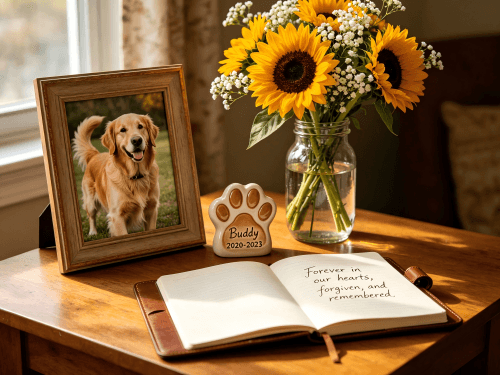
For many grieving pet owners, one memory refuses to let go.
Not the happy memories.
Not the years of companionship.
Not the vacations, walks, cuddles, or funny moments.
Instead, the mind becomes stuck on a single interaction.
Maybe you were tired.
Maybe you were stressed.
Maybe your dog barked at the wrong moment.
Maybe your cat knocked something over.
Maybe you were rushing out the door.
And you reacted with frustration.
You raised your voice.
You said "No."
You felt annoyed.
Then, days later—or perhaps even hours later—your pet was gone.
Now that moment feels enormous.
It plays on repeat.
And the thought keeps coming back:
"Why was I angry?"
"What if those were my last words?"
"Did they think I didn't love them?"
"If I could go back, I would do everything differently."
If you're carrying this kind of guilt, you're not alone.
Many grieving pet owners find themselves haunted by one imperfect moment after loss.
And while that pain is real, it may not be telling the full story.
One of the cruelest things about grief is how selective memory can become.
Out of thousands of interactions, the mind often chooses one difficult moment and shines a spotlight on it.
Maybe your dog had an accident on the floor.
Maybe they woke you up in the middle of the night.
Maybe they refused medication.
Maybe they chewed something valuable.
You reacted the way many exhausted humans react.
With impatience.
Frustration.
Annoyance.
At the time, it probably felt like an ordinary moment.
A normal part of living together.
But after loss, that same interaction can begin to feel unbearable.
Suddenly it seems like the only thing that matters.
The final chapter begins to overshadow the entire book.
Guilt is one of the most common emotions in grief.
In fact, many people experience guilt even when they did absolutely nothing wrong.
Why?
Because guilt creates the illusion of control.
If you can find something you should have done differently, then maybe the loss feels more understandable.
Maybe it feels less random.
The mind starts searching:
"What if I had noticed symptoms sooner?"
"What if I chose a different treatment?"
"What if I stayed home that day?"
"What if I hadn't yelled?"
The problem is that grief gives us access to information we didn't have at the time.
This is called hindsight bias.
Looking backward, everything feels obvious.
But when the moment was actually happening, you were simply being human.
You didn't know what was coming.
You didn't know that ordinary day would become extraordinary.
And because you didn't know, you responded the way people often respond during ordinary life.
Imagine reducing an entire friendship to one disagreement.
Or a marriage to one argument.
Or a parent-child relationship to one stressful afternoon.
It wouldn't make sense.
Relationships are built over time.
The same is true with pets.
Your relationship wasn't one moment.
It was thousands.
Thousands of feedings.
Thousands of greetings.
Thousands of acts of care.
Thousands of shared routines.
Thousands of opportunities for your pet to learn one thing:
You loved them.
Grief often zooms in on a single frame and forgets the entire movie.
But your pet experienced the whole movie.
Not just one scene.
This is perhaps the question that hurts the most.
"Did my dog know I loved him?"
The answer rarely lives in one final interaction.
It lives in the years before it.
Your dog knew who fed them.
Who comforted them during storms.
Who took them on walks.
Who protected them when they were scared.
Who celebrated birthdays.
Who sat beside them when they were sick.
Who came home every day.
Who loved them consistently.
Dogs and cats don't evaluate relationships the way humans often do.
They experience patterns.
Trust.
Safety.
Connection.
And if your pet spent years seeking your presence, following you from room to room, sleeping near you, greeting you at the door, the evidence is already there.
They knew.
For a deeper exploration of this question, read:
Almost every grieving pet owner has a list.
A final walk they wish they had taken.
A photo they wish they had captured.
A cuddle they wish had lasted longer.
A moment they wish they had appreciated more fully.
The list can feel endless.
But these regrets often emerge because loss changes perspective.
We suddenly know what mattered most.
The problem is that we only gain this clarity after the fact.
No one lives every ordinary day as if it's the last.
Because ordinary days aren't supposed to feel extraordinary.
The regret you feel now is not evidence that you failed.
It's evidence that you loved deeply.
When grief is intense, the brain often becomes drawn to painful memories.
It wants answers.
It wants certainty.
It wants to understand.
This is why many people become stuck replaying:
If this sounds familiar, you may also find comfort in:
Why Can't I Stop Replaying My Pet's Final Moments?
and
What Grief Really Feels Like After Losing a Pet
These experiences are surprisingly common among grieving pet owners.
Imagine your dog's perspective.
What did they experience most often?
Not one stressful morning.
Not one impatient moment.
Not one raised voice.
They experienced your presence.
Your routines.
Your affection.
Your consistency.
Your care.
Animals build trust through repetition.
And over years together, your actions told the story far more clearly than any single interaction ever could.
The relationship your pet knew was the relationship you built every day.
Not the one moment your grief keeps replaying.
This doesn't mean your guilt disappears overnight.
Grief rarely works that way.
But over time, many people begin shifting their focus.
Instead of asking:
"Why wasn't I perfect?"
They begin asking:
"How did I love them?"
Instead of reliving one painful interaction, they begin remembering hundreds of meaningful ones.
Some people find comfort through remembrance rituals.
A photo album.
A favorite collar.
A memory box.
A framed paw print.
A piece of memorial jewelry.
Not because these things erase guilt.
But because they help redirect attention toward the relationship itself.
Toward the love.
Toward the life that was shared.
You may find inspiration in:
Pet Remembrance After Loss: How We Keep Love and Memory Alive
If you're carrying guilt because you were angry at your dog before he died, you're carrying a burden many grieving pet owners know well.
The regret feels real.
The sadness feels real.
The wish for a do-over feels real.
But one difficult morning cannot erase years of love.
One impatient moment cannot rewrite an entire relationship.
Your pet knew you through thousands of acts of care.
Thousands of ordinary moments.
Thousands of opportunities to experience your love.
And that's the relationship they carried with them.
Not a single mistake.
Not a single bad day.
Not a single moment your grieving heart refuses to forget.
Your pet knew your heart long before that moment happened.
And one imperfect interaction cannot erase a lifetime of love.

July 20, 2026
Losing a dog to parvo is heartbreaking, especially if they were vaccinated. Learn why guilt is so common after parvovirus, how to cope with pet loss, and gentle ways to honor your dog's memory.
July 15, 2026
Was your pet your soulmate? Discover why some dogs and cats become our deepest emotional companions, why losing a soulmate pet hurts so much, and gentle ways to honor their memory.

July 11, 2026
"I want people to know my dog existed." If you've lost a beloved dog and fear they'll be forgotten, you're not alone. Learn why sharing memories is a natural part of grief and meaningful ways to honor your dog's life.