Free US Shipping on orders $100+
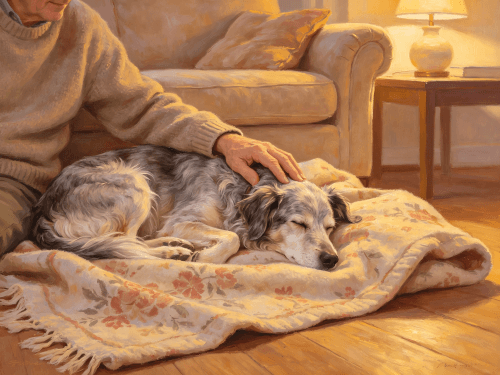
One day your dog seems almost like themselves again.
They greet you at the door.
They eat breakfast with enthusiasm.
They wag their tail when you pick up the leash.
For a few precious hours, hope returns.
Maybe the medication is working.
Maybe they're improving.
Maybe there is still more time.
Then a few days later, everything changes.
They're struggling to stand.
They refuse food.
They seem exhausted.
You spend the evening wondering whether they're suffering more than they're enjoying life.
If you're caring for an elderly or terminally ill dog, this emotional roller coaster may feel painfully familiar.
Many pet owners describe this period as one of the hardest experiences they've ever faced.
Not because they don't love their dog.
But because they do.
The love that makes us want to hold on is often the same love that makes us wonder whether letting go might be kinder.
Somewhere between the good days and the bad days, a heartbreaking question begins to emerge:
"How do I know if it's time?"
Unfortunately, there is rarely a perfectly clear answer.
But understanding why the decision feels so difficult may help you navigate it with a little more compassion for both your dog and yourself.
Few decisions carry as much emotional weight as deciding whether it's time to say goodbye to a beloved dog.
Part of the difficulty comes from being pulled in two opposite directions at the same time.
On one side is the fear of acting too soon.
You worry that your dog still has meaningful time left.
You fear taking away days, weeks, or months that could have been spent together.
You imagine future moments that might never happen.
On the other side is the fear of waiting too long.
You worry about suffering.
You worry about pain.
You worry about your dog enduring difficult days simply because you're not ready to say goodbye.
Most owners aren't choosing between a clearly right answer and a clearly wrong answer.
They're trying to navigate uncertainty while carrying enormous emotional responsibility.
That uncertainty is what makes the decision feel so overwhelming.
The fact that you're questioning yourself doesn't mean you're failing.
It usually means you're taking the decision seriously.
When veterinarians discuss end-of-life decisions, they often focus on something called quality of life.
Quality of life isn't about perfection.
It's about whether a pet is still able to experience enough comfort, enjoyment, and dignity to make daily life meaningful.
Several areas are commonly considered.
Can your dog move comfortably?
Are they able to stand, walk, or reposition themselves without severe distress?
Many senior dogs experience arthritis, weakness, or neurological decline.
Some limitations can be managed successfully.
Others gradually become more debilitating.
Is your dog still interested in eating?
Do they enjoy treats?
Are they drinking enough water?
Temporary appetite changes can happen for many reasons.
However, a sustained loss of interest in food often signals a significant decline in wellbeing.
Are pain medications helping?
Can your dog rest comfortably?
Are they experiencing ongoing discomfort that no longer responds well to treatment?
Comfort is one of the most important factors in assessing quality of life.
This question can sometimes be the most meaningful.
Does your dog still experience moments they genuinely enjoy?
Do they seek affection?
Do they respond to favorite activities?
Do they still show interest in the world around them?
Joy doesn't need to look exactly the way it did years ago.
But signs of engagement can provide valuable insight into how a dog is experiencing daily life.
Perhaps the most difficult part of the journey is when a dog continues having occasional good days.
A dog who struggled all week may suddenly seem brighter.
They may eat a full meal.
They may want to go outside.
They may even appear happy.
Naturally, owners interpret these moments as signs of recovery.
And sometimes they are.
But in many cases involving advanced illness, these good days represent temporary rallies rather than lasting improvement.
Terminal conditions are rarely linear.
Health often fluctuates.
There are better days and worse days.
Periods of comfort and periods of decline.
One good day doesn't necessarily erase what happened before.
Nor does it guarantee what comes next.
This is one reason families often feel trapped between hope and concern.
The good moments are real.
But so are the difficult ones.
Both deserve consideration.
Veterinarians often encourage families to focus on patterns rather than isolated moments.
Instead of asking:
"Was today a good day?"
Try asking:
"What have the last two weeks looked like?"
Or:
"Are the bad days becoming more frequent?"
Sometimes keeping a simple journal can help.
Record:
Over time, patterns often emerge that are difficult to see in the moment.
Many owners later say this approach helped them make a more informed and compassionate decision.
Because when emotions are intense, a single good afternoon can sometimes overshadow a broader decline.
At some point, many loving owners quietly ask themselves a painful question:
"Am I doing this for them or for me?"
It's a difficult question because the answer is rarely simple.
Most people are motivated by both love and fear.
Love makes us want to protect our dogs.
Fear makes us afraid of losing them.
Neither emotion is wrong.
The challenge is separating our desire to avoid personal heartbreak from our responsibility to consider our dog's wellbeing.
Many owners worry that choosing euthanasia means giving up.
Others worry that continuing treatment means asking their dog to carry suffering longer than necessary.
The reality is that these concerns often coexist.
And the very fact that you're asking the question demonstrates how deeply you care.
Veterinarians frequently observe a pattern among families facing end-of-life decisions.
Most owners worry about being too early.
Very few worry about being too late.
This makes sense.
The possibility of missing additional time feels devastating.
The possibility of a few more happy moments feels incredibly valuable.
As a result, many families continue hoping for improvement even when decline has become significant.
Veterinarians sometimes share a difficult observation:
Many owners later express concern that they waited too long.
Far fewer feel they acted too early.
This doesn't mean every situation is the same.
But it highlights how powerfully love and hope can influence decision-making.
Wanting more time is one of the most natural human responses to impending loss.
One of the hardest truths to accept is that there is rarely a perfect moment.
Most people imagine a clear sign.
A definitive answer.
A day when everything suddenly becomes obvious.
But for many pets, that day never arrives.
Instead, families are left making decisions in shades of gray.
There may still be tail wags.
There may still be moments of joy.
There may also be increasing discomfort, confusion, weakness, or suffering.
The decision often happens before every good moment disappears.
And that's part of what makes it so painful.
Waiting for certainty can sometimes mean waiting until a pet experiences significant distress.
Yet acting earlier can create fears about whether the decision was premature.
This uncertainty is why so many grieving owners later ask:
Did I Put My Cat Down Too Soon?
The question is common precisely because certainty is rare.
When faced with uncertainty, many people try to focus on one guiding principle:
Making decisions from love rather than fear.
Fear asks:
"What if I lose more time?"
"What if I'm wrong?"
"What if I regret this?"
Love asks:
"What does my dog need?"
"What would spare them unnecessary suffering?"
"What choice best reflects the care I've given throughout their life?"
Neither approach eliminates pain.
But one centers your dog's wellbeing.
The other centers uncertainty.
Most pet owners eventually realize they cannot eliminate regret completely.
They can only make the most compassionate decision available with the information they have.
And often, that's enough.
If you and your veterinarian determine that the time is approaching, it's normal to feel overwhelmed.
Some families find comfort in learning what to expect ahead of time.
You may find these resources helpful:
Preparing emotionally doesn't make the loss easier.
But it can help reduce some of the uncertainty surrounding the process.
If your dog has good days and bad days, you're standing in one of the most difficult places a pet owner can face.
A place where hope and heartbreak often exist side by side.
A place where every decision feels heavy.
A place where certainty seems impossible to find.
You may never feel completely ready.
Most people don't.
You may continue questioning yourself.
That's normal too.
What matters most is remembering why you're asking these questions in the first place.
Because you love your dog.
Because you want to protect them.
Because you want to do right by them.
And that desire alone says something important about the relationship you've built together.
Your dog does not need a perfect decision.
Your dog does not need a perfect owner.
They simply need the person who has loved them all along.
The person they have trusted through every stage of life.
The person who is now carrying the weight of an impossible choice because their comfort matters more than anything else.
And whatever decision eventually comes, that love will remain part of the story forever.
Create a beautiful free digital memorial to celebrate your pet's life. Share memories, light candles, and keep their spirit alive forever.
Meet beloved pets waiting at Rainbow Bridge
July 25, 2026
Is it normal to see your pet after they die? Many grieving pet owners briefly see, hear, or sense their beloved companion after loss. Learn why these experiences are common and how they can bring comfort during pet grief.

July 20, 2026
Losing a dog to parvo is heartbreaking, especially if they were vaccinated. Learn why guilt is so common after parvovirus, how to cope with pet loss, and gentle ways to honor your dog's memory.
July 15, 2026
Was your pet your soulmate? Discover why some dogs and cats become our deepest emotional companions, why losing a soulmate pet hurts so much, and gentle ways to honor their memory.